
Get Your Free Quote


Here are some frequently asked questions (FAQ)

How do you work out your prices?

For carpet cleaning, prices are based on the size of the areas you want cleaned and how many steps you have. We have a minimum charge of £105 for the first area. The minimum price per area is £35, with discounts available for larger properties. Stain removal starts from £120 for the first hour. Upholstery and leather cleaning start from £50 per seat. Rugs are priced per square metre with a minimum charge of £150. (Prices as of 2025.)

We’re happy to provide a free estimate over the phone or via WhatsApp if you can give rough measurements. Otherwise, we can arrange a home visit to pre-inspect and measure the property.


Do you have insurance?

Yes. We are fully insured with £5 million public liability cover, along with “items worked upon” insurance for added protection.


What makes your service different from others?

We are fully advanced NCCA members, IICRC members and Trading Standards accredited. We work to the British Standards Institute PAS86 standard. We’re also one of Shropshire’s only IICRC commercial cleaning technicians. We regularly update our training and even provide training to new and experienced cleaners — so you’re always in safe hands.

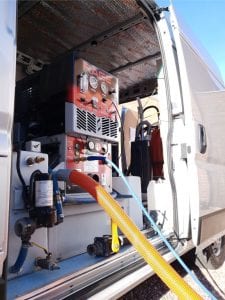
We’ve been cleaning carpets in Telford and Shropshire for over 20 years. Jared is also a trained carpet installer and carpet inspector. We use a powerful truck-mounted system with our own onboard water supply and off-site waste disposal — never down your toilet.

Our biggest strength is our customer service. Many clients have stayed with us for nearly 20 years because we offer a personal, old-fashioned level of service rarely seen these days.


How often should I have my soft furnishings cleaned?

Most manufacturers recommend professional wet extraction every 12–18 months. Regular vacuuming with an upright cleaner is recommended weekly. We can offer tailored advice based on your soft furnishings and carpet types.


I’ve had cheaper quotes. Why are your prices higher?

Not all cleaning companies work to the same standards. We follow strict procedures, invest heavily in training, insurance and equipment, and we prioritise customer service and long-term results. Some companies use low-cost equipment or skip essential steps (“splash and dash”), which often leads to damage or rapid re-soiling.

Our quotes are transparent and based on a proper pre-inspection. There are no hidden charges, no add-ons, and no upselling. Check our reviews — they reflect the quality and care we put into every job.


Can you remove tough stains like red wine or pet urine?

Carpets take a beating, so it’s normal for them to get spots and stains. Many spots are easy to remove; true stains (where colour has been added to the fibre) are more complex. While we’ve removed countless stains, no company can guarantee every stain will come out. Using supermarket stain removers can often set stains permanently — we advise against them.

Urine and odour issues usually require sub-surface treatment. We specialise in odour removal; please see our odour removal page for full details.


How long do carpets take to dry after cleaning?

Most carpets are touch-dry within 2–4 hours. Our truck-mounted system extracts more moisture than DIY or portable machines, helping carpets dry faster. We also use speed-drying equipment where needed, so most carpets and upholstery are usable the same day.


My carpet became dirty quickly after a previous clean. Why?

This is usually caused by detergent residue being left behind during cleaning. Residues attract dirt, causing rapid re-soiling. We use free-rinsing, eco-friendly products that break the bond between dirt and fibres, allowing them to rinse cleanly away.


Are your products safe for children and pets?

Absolutely. Our products are safe, non-toxic and WoolSafe approved — safe for children, pets and allergy sufferers. If you have a specific sensitivity, just let us know, and we’ll choose the right products for you.


Do you cover all of Telford and the surrounding areas?

We cover Telford & Wrekin, Shrewsbury and a wide range of surrounding areas throughout Shropshire. Some locations outside our main radius may incur a small travel charge.


Can you quote over the phone?

We can sometimes give an estimate based on your room sizes. However, for accuracy and fairness, we prefer a free home survey. Every property is different, and factors like soiling levels and fibre types affect the final price. A home visit ensures you get an accurate quote with no surprises.

If you have any other questions, please don’t hesitate to contact us.

Carpet 7 point process

1. Pre-Survey

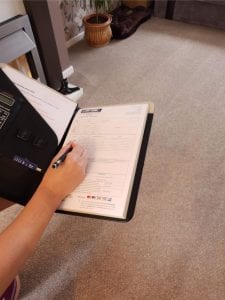
This is carried out on all carpets that will be potentially cleaned. This is for fibre identification, to check for existing damage, potential problems and in some cases, cleaning limitations. The results will be fully discussed with the customer before any work is carried out

2. Pre-Clean Vacuuming

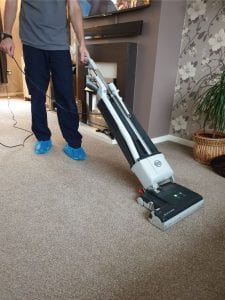
Around 80-85% of soiling in carpets is dry particulate dust/grit type soiling. The first important stage of all cleaning processes is to remove as much dry soiling as possible before wetting the carpet. All carpets are pre-vacuumed with a heavy-duty commercial grade vacuum cleaner.

3. Spotting & Pre-Spray

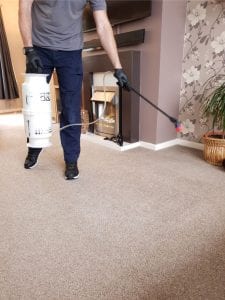
Some carpets may have spots and stains that need separate attention before the carpet is pre-sprayed. After these have been treated the carpet will be pre-sprayed with a product appropriate to the soiling and fibre type.

4. Agitation

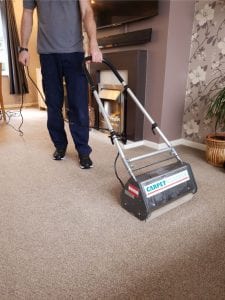
Done by a machine, this is used to open the carpet pile and works the cleaning solution into the carpet fibres allowing it to work on the deeper down soils and preparing the carpet for rinse extraction. Agitation is a very important part of the cleaning process and commonly skipped by cleaning companies.

5. Rinse extraction

Solution is jetted into the carpet at over 110degrees C and over 250psi. The wand pass then extracts the solution and soiling and is lifted out by our truck mounted cleaning system* and wastewater is recovered back into our vehicle. This leaves your carpets smelling fresh and free from cleaning solutions. * dependant on access

6. Drying

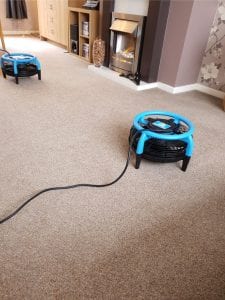
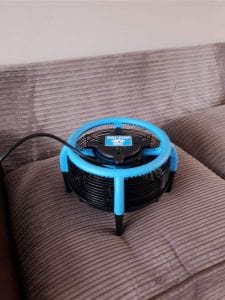
Our extraction equipment will typically leave your carpets touch dry within a few hours, but as part of the service and for extra convenience, we use our air movers which will help dry the carpets fast if required.

7. Final groom and run through

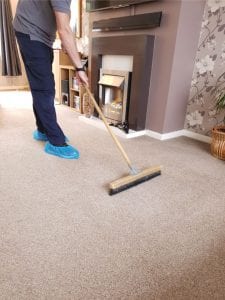
Carpets are groomed if required and then we’ll run through the finishing details and ask you to check your happy and then its time to say goodbye

Our truck mounted cleaning system benefits

Q: What are the benefits or a truck-mounted cleaning system over a portable machine?

A: There is a huge difference between a portable machine using electric from a typical plug and a petrol-driven engine. We have our own power supply and bring our own filtered water supply to all jobs. It allows for such a variety of benefits. We have listed them below to explain in better detail:

1. Immense Heat

Our truck mount produces immense temperatures of over 230 degrees F. These temperatures kill bacteria, germs, and viruses in your soft furnishings and are simply not available from the average tap.

2. Vacuum Power

Our truck mount can extract nearly twice as much moisture from soft furnishings compared to most high-spec portables. This allows carpets to dry quicker and leave a superior result.

3. Rinsing Power

We have our own water supply on board, so there’s no need to use your water and fill buckets. Our truck mount can flush pollutants from your carpets & upholstery deeper and faster with the reassurance it is being fully extracted.

4. Waste Removal

In the unique times we are in, we can reassure you all waste from your soft furnishings is secured into our van mounted waste tank and disposed of off site. We do not tip contaminated waste or soiling down your toilets or around your property. All pollutants are exhausted outside at the machine and not back into your property.

Watch our truck mount in action

Upholstery 7 point process

1. Pre-Survey

This is carried out on all carpets that will be potentially cleaned. This is for fibre identification, to check for existing damage, potential problems and in some cases, cleaning limitations. The results will be fully discussed with the customer before any work is carried out

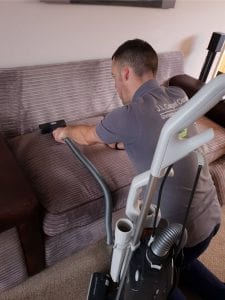
2. Pre-Clean Vacuuming

Around 80-85% of soiling in carpets is dry particulate dust/grit type soiling. The first important stage of all cleaning processes is to remove as much dry soiling as possible before wetting the upholstery. All upholstery is pre-vacuumed with a heavy-duty commercial grade vacuum cleaner.

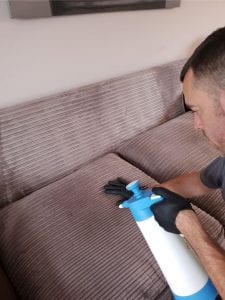
3. Spotting & Pre-Spray

Some upholstery may have spots and stains that need separate attention before the fabric is pre-sprayed. After these have been treated the fabric will be pre-sprayed with a product appropriate to the soiling and fibre type.

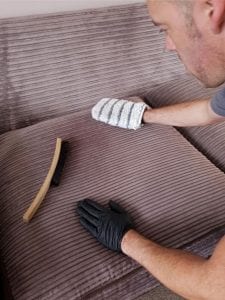
4. Agitation

Done by a machine or by variety of methods. This is used to work the cleaning solution into the fibres allowing it to work on the deeper down soils and preparing the upholstery for rinse extraction. Agitation is a very important part of the cleaning process and commonly skipped by cleaning companies.

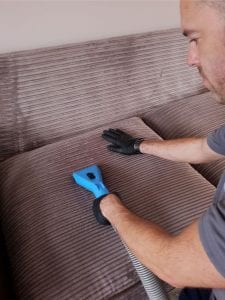
5. Rinse extraction

The solution and soiling are then lifted by our water extraction machine using the latest in upholstery cleaning tools, the Sapphire Pro. These are designed to clean the fabric without spraying water deep into the cushion, meaning that over wetting is eliminated, and the drying time is a lot faster

6. Drying

Our extraction equipment will typically leave your fabrics touch dry within a few hours, but as part of the service we will speed dry the fabrics as much as possible prior to leaving.

7. Final groom and run through

The upholstery is groomed if required and then we’ll run through the finishing details and ask you to check your happy and then its time to say goodbye

Carpet fibres, a guide to which carpet to buy


carpet fibres, a guide to which carpet to buyChoosing a carpet can become a bit of a headache. Walking into carpet shops and seeing the vast array of samples can sometimes be very daunting. What type of carpet are you planning to buy

What type of  carpet Fibres will you choose?

What style or type will you buy?

What type of finish and thickness will you have?

These are obviously all personal choices when it comes to choosing your carpet but the following information will help you get familiar with carpet fibre types so you can make a more informed and educated decision on choosing your next carpet when it comes to that time.


CARPET FIBRES

Before we talk about carpet fibres its important to understand there isn’t just one thickness or density to every carpet. Like all things the denser the  carpet pile, or thicker the carpet pile is the more expensive it will become. Some terms to remember are as follows:

Gauge

The gauge is the distance between the needles on a tufting machine, The gauge is measure in fractions of an inch, and refers to the number of needles which are positioned across the width of the tufting machine. Therefore the more needles per square inch the denser the pile, and  the better constructed the carpet. Carpets with a high gauge count will wear at a much slower rate than carpets with a lesser count as the carpet has a higher density. This gauge is usually found in higher end wool carpets

Pile Weight

The weight, measured in the number of ounces per yard of carpet fibres ( not including the carpet backing ) A higher oz per yard would indicate a thicker pile i.e a 90oz would be far thicker to a 30oz carpet


Whilst there are many types of carpet fibres used in carpet and rug construction. There are four main types which you’ll find are the most commonly used in carpet production today. Below we shall go through each type giving some pros and cons with each one.

POLYPROPYLENE (OLEFIN)

polypropylene carpet example


Polypropylene is one of the most used and versatile of the carpet fibres and is used in the construction of carpet backing also. It is also cheap to produce.


PROS

  • Highly stain resistant and moisture resistant
  • Chemical Resistant – Most chemicals and bleaches won’t damage it at all
  • Solution dyed, making it highly resistant to sun fading, so keeps its colour longer
  • Its very strong and wears well except for resiliency factor (see cons).
  • It is easy to clean and remove stains from. (Except oil/petroleum-based stains – see cons)

CONS

  • Polypropylene is not a resilient carpet fibre. When crushed it does not regain its original shape easily. Traffic areas tend to lie down, showing “apparent soiling”. Furniture marks can be permanent reminders to the owner of where his furniture used to be.
  • It sensitive to heat with a melting point around 300 degrees. Damage though can occur at lower temperatures.
  • Carpet Fibres can be damaged by Friction when dragging heavy pieces of furniture across the carpet
  • Oil-based stains may become permanent.


POLYESTER

Probably the least used out of the four main carpet fibres. Whilst again cheap to produce it has some limitations when it comes to being used in carpets

PROS

  •  it is usually solution dyed which makes it very resistant to bleaching and fading
  • Stain Resistant, though only to water based stains.
  • Low moisture Absorbency, therefore Quick drying

CONS

  • Polyester is difficult to dye and usually must be solution dyed which limits the choice
  • It is not resistant to oily stains, and in fact an oily spill or spot left without proper cleaning can oxidize and even chemically bond with and become part of the carpet fibre. You need to know that some of these spots just won’t come out.
  • Pile flattening. Definite improvements have been made by heat setting and using finer yarns, but pile flattening can still be a problem. This is a characteristic of polyester, not a defect.


NYLON (POLYMIDE)

Nylon can be found as two types, nylon 6 & 6.6. In earlier days there was a difference between the two as 6.6 was regarded as being superior in terms of colour fastness, over years improvements now leave little between them. Nylon carpets cover a wide range of situations from contract to super soft luxury.

PROS

  • Wears extremely well. It even surpasses wool. Many manufacturers offer long wear warranties.
  • Good resiliency. Nylon can be crushed for long periods and still regain its original shape.
  • Non absorbent,
  • Mildew resistant
  • Nylon responds very well to most professional cleaning methods and treatments. Carpet cleaning on a regular basis, will improve it longevity

CONS

  • The Nylon carpet fibre is sometimes acid dyed, so it can have problems with bleaching, fading, urine reactions, these carpets sometimes have stain protector applied. This will need reapplying yearly. These cons don’t apply to solution dyed nylon


WOOL

wool carpet example

Wool comes from the fleece of sheep or lambs. This is one of the oldest carpet fibres used by man. It is still one of the best carpet fibres available for a carpet, but also can be the most expensive.


PROS

  • Wool has excellent soil hiding capabilities. Wool will not show some soiling as much as other carpet fibres. The reason for this is that wool is an opaque fibre (as opposed to synthetics which are transparent) and wool doesn’t refract and reflect light like synthetics.
  • Wool is very strong. Wool used in well-constructed carpets will stand up to the heaviest traffic and still look beautiful. Most heavy traffic areas in hotels, pubs restaurants use wool in some shape or form
  • Wool is naturally flame retardant.

CONS

  • Wool is a very expensive carpet fibre to process. i.e the cleaning and preparation to produce the yarn. Therefore finished goods will be more expensive than manmade carpets.
  • Wool can Stain Easily due to its absorbency and ease of dyeing.
  •  Wool can be chemically sensitive to alkaline cleaning products above a pH of 9.5 after prolonged exposure especially bleach. This exposure will tend to make wool brittle and discolor somewhat and can cause permanent damage to the carpet fibres. It is recommended to keep the ph around 8 or below, and ideally it should be left in a mildly acidic state when having your carpets cleaned professionally.
  •  Rubbing Wool can cause fuzzing and pile distortion, this can help when cleaning stains. It is recommended to blot with a plain white towel only and not to excessively rub the carpet

Thanks for reading part 1, I hope this has been of some help. Check back next time when we go over carpet types and styles


by jared long


Back to top